
Should You Hold Your Child Back for Sports? The Numbers Tell a Different Story.

Every few years, a new trend sweeps through youth sports.
Today, it’s “redshirting” eighth grade—parents intentionally delaying their child’s entry into high school so they’ll be older, bigger, stronger, and hopefully have a better chance at earning a Division I scholarship…and maybe even life-changing NIL money.
On the surface, it sounds like a smart investment.
One extra year of physical maturity.
One extra year to develop.
One extra year to stand out.
But before making one of the biggest educational decisions your family may ever face, it’s worth asking one simple question:
What are the actual odds?
The answer may surprise you.
⸻
The Reality: Very Few High School Athletes Ever Play Division I
Social media has made it feel like everyone is committing to Alabama, Texas, Ohio State, or Georgia.
They’re not.
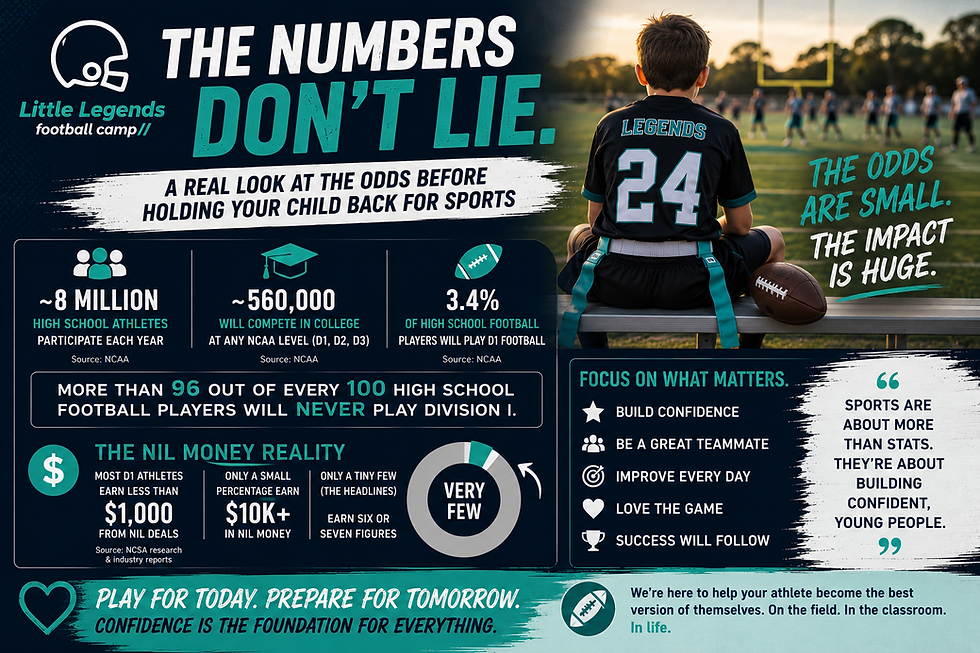
According to the NCAA, nearly 8 million students participate in high school athletics every year.
Only about 560,000 will compete at any NCAA level—Division I, II, or III.
Now let’s narrow it further.
For football—the sport where many families discuss holding a child back—the numbers become much smaller.
Out of more than 1 million high school football players, only 3.4% will ever play Division I football.
That means…
More than 96 out of every 100 high school football players will never play Division I football.
Think about that for a moment.
Holding a child back an entire academic year is often being discussed to improve odds that are already extremely small.
⸻
Making Division I Doesn’t Mean You’re Getting Rich
Here’s where the conversation usually shifts.
Parents often say:
“But NIL has changed everything.”
Yes.
It has.
But not in the way social media often portrays it.
When people think of NIL, they think of athletes like:
Arch Manning
Livvy Dunne
Cooper Flagg
Caitlin Clark
Those athletes are exceptions—not the rule.
They’re the headlines.
Not the average.
⸻
Most Division I Athletes Will Never Receive Significant NIL Money
The reality is that the vast majority of college athletes are not earning six figures—or even five figures—from NIL.
Most NIL deals are relatively small and often consist of:
* Free meals
* Apparel
* Local business promotions
* Social media posts
* A few hundred dollars
* Occasionally a few thousand dollars
Only a very small percentage of athletes—primarily those in high-profile football and men’s basketball programs at major conferences—receive substantial NIL compensation.
Community discussions among recruiting experts consistently note that while NIL dominates headlines, most athletes make less than $1,000 from traditional NIL opportunities, with the multimillion-dollar deals representing rare outliers.
Even with the recent changes allowing some schools to directly share revenue with athletes, the largest financial opportunities remain concentrated among a relatively small number of athletes in revenue-generating sports.
⸻
The Goal Shouldn’t Be NIL
The irony is this…
Families can become so focused on scholarships and NIL money that they forget why kids started playing sports in the first place.
Sports teach things that last much longer than an endorsement deal.
Confidence.
Leadership.
Resilience.
Discipline.
Teamwork.
Handling adversity.
Learning how to compete.
Those lessons matter whether your child finishes their career in youth football, high school football, Division III, Division I, or never plays another snap after graduation.
⸻
Are There Benefits to Waiting?
Absolutely.
Every child develops differently.
For some students, delaying school for academic, emotional, or social reasons can make sense.
Some athletes genuinely benefit from another year of physical development.
There’s nothing inherently wrong with that.
But if the decision is being made primarily because of dreams of Division I football or NIL money, it’s important to understand just how long the odds really are.
⸻
Focus on What You Can Control
At Little Legends Football, we believe the conversation should look different.
Instead of asking:
“How do we give my child an advantage over everyone else?”
Ask:
Are they having fun?
Are they becoming more confident?
Are they improving every season?
Are they learning to love competition?
Are they becoming a better teammate?
Those are the things that create long-term success—on the field and off it.
Ironically, those are also the qualities college coaches consistently look for.
⸻
Play the Long Game
Could your child become a Division I athlete?
Absolutely.
Could they earn meaningful NIL money someday?
It’s possible.
But neither outcome is something parents can—or should—build a childhood around.
The statistics remind us that chasing the tiny percentage often comes at the expense of enjoying the much bigger picture.
Youth sports aren’t just about producing college athletes.
They’re about producing confident young people.
At Little Legends Football, that’s the goal every time we step onto the field.
Because if confidence is the foundation, success—whatever that looks like for your child—has a much better chance of following.


